https://en.wikipedia.org/wiki/Darwinius
Darwinius is a genus within the infraorder Adapiformes, a group of basal strepsirrhine primates from the middle Eocene epoch. Its only known species, Darwinius masillae, lived approximately 47 million years ago (Lutetian stage) based on dating of the fossil site.[1]
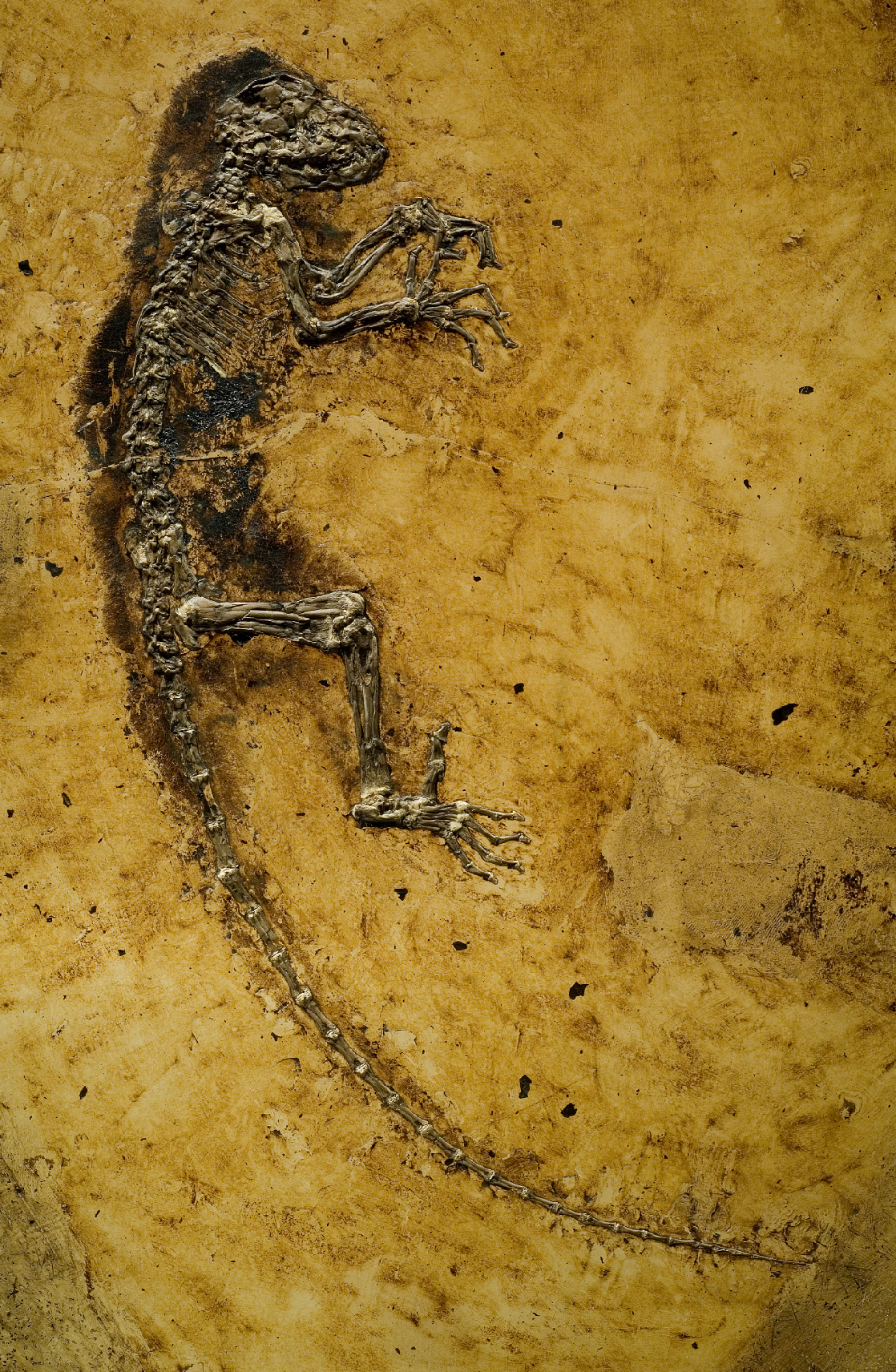
The only known fossil, called Ida, was discovered in 1983[2] at the Messel pit, a disused quarry near the village of Messel, about 35 km (22 mi) southeast of Frankfurt, Germany. The fossil, divided into a slab and partial counterslab after the amateur excavation and sold separately, was not reassembled until 2007. The fossil is of a juvenile female, approximately 58 cm (23 in) overall length, with the head and body length excluding the tail being about 24 cm (9.4 in). It is estimated that Ida died at about 80–85% of her projected adult body and limb length.[3]
The genus Darwinius was named in commemoration of the bicentenary of the birth of Charles Darwin, and the species name masillae honors Messel where the specimen was found. The creature appeared superficially similar to a modern lemur.[3][4]
The authors of the paper describing Darwinius classified it as a member of the primate family Notharctidae, subfamily Cercamoniinae,[3] suggesting that it has the status of a significant transitional form (a "link") between the prosimian and simian ("anthropoid") primate lineages.[5] Others have disagreed with this placement.[6][7][8]
Concerns have been raised about the claims made about the fossil's relative importance and the publicising of the fossil before adequate information was available for scrutiny by the academic community.[4] Some of Norway's leading biologists, among them Nils Christian Stenseth, have called the fossil an "exaggerated hoax" and stated that its presentation and popular dissemination "fundamentally violate scientific principles and ethics."[9][10][11]
Contents
Taxonomy
Franzen et al. (2009) place the genus Darwinius in the subfamily Cercamoniinae of the family Notharctidae within the extinct infraorder Adapiformes of early primates.[3]Darwinius masillae is the third primate species to be discovered at the Messel locality that belongs to the cercamoniine adapiforms, in addition to Europolemur koenigswaldi and Europolemur kelleri. Darwinius masillae is similar but not directly related to Godinotia neglecta from Geiseltal.
The adapiforms are early primates which are known only from the fossil record, and it is unclear whether they form a suborder proper or a paraphyletic grouping. They are usually grouped under Strepsirrhini—including lemurs, aye-ayes and lorisoids—and as such would not be ancestral to Haplorrhini, which includes tarsiers and simians.[12] Simians are usually called "anthropoid": while this term can be confusing, the paper uses it, as does associated publicity material. Simians (anthropoids) include monkeys and apes, which in turn includes humans.[13]

CT image of the skull of Darwinius.
Concerns over cladistic analysis
Paleontologists have expressed concern that the cladistic analysis compared only 30 traits when standard practice is to analyze 200 to 400 traits and to include fossils such as anthropoids from Egypt and the primate genus Eosimias which were not included in the analysis. This contrasts with the motive openly stated by the authors, which was to list 30 anatomical and morphological characteristics "commonly used" to distinguish extant strepsirrhine and haplorrhine primates.[3] Paleontologist Richard Kay of Duke University thought the data could have been cherry-picked. Paleontologist Callum Ross of the University of Chicago considered the claim that Darwinius should be classified as haplorhine was "unsupportable in light of modern methods of classification."[14] The opinion of Chris Beard, curator of vertebrate paleontology at the Carnegie Museum of Natural History, was that Darwinius was not a "missing link" between anthropoids and more primitive primates, but that further study of this remarkably complete specimen would be very informative and could reveal relationships amongst "the earliest and least human-like of all known primates, the Eocene adapiforms."[15] In an interview published on 27 May 2009, Jørn Hurum stated that he had an open mind about the possibility that the fossil might turn out to be a lemur and that a paper on systematics to be published within about a year would mainly focus on the partial counterslab containing the inner ear and the foot bones.[16]Most experts hold that the higher primates (simians) evolved from Tarsiidae, branching off the Strepsirrhini before the appearance of the Adapiformes. A smaller group agrees with Franzen et al. that the higher primates descend from Adapiformes (Adapoidea). The view of paleontologist Tim White is that Darwinius is unlikely to end the argument.[17]
Philip D. Gingerich states that the seven superfamilies of primates are commonly associated in the higher taxonomic groupings of suborders Anthropoidea and Prosimii as an alternative to Haplorhini and Strepsirrhini, depending on the position of Adapoidea and Tarsioidea. He puts forward a phylogeny in which the higher primates evolved from Darwinius, which he groups with other Adapoidea. He shows the Adapoidea together with the Tarsioidea as representing early diversification of the suborder Haplorhini and shows the Strepsirrhini as having branched off directly from the earliest primates.[18] The Revealing the Link website uses this taxonomic grouping and states that Darwinii is from an early group of primates just prior to diversification into the anthropoids (monkeys, apes and humans) and the prosimians (lemurs, lorises and tarsiers).[19]
Erik Seiffert and colleagues at Stony Brook University argue that Darwinius is on the branch towards the Strepsirrhini and is not a 'missing link' in the evolution of the Anthropoidea.[20] A phylogenetic analysis of 360 morphological characters in 117 extinct and modern primates places Darwinius in a now-extinct group of strepsirrhines along with a newly discovered 37-million-year-old Egyptian primate, Afradapis. Seiffert believes that characteristics that appeared to show a relationship to haplorrhines are due to convergent evolution[21] and has said that "the PR hype surrounding the Darwinius description was very confusing.”[22]
Type specimen

Counter-slab of the Darwinius masillae holotype fossil (specimen
WDC-MG-210 reversed for comparison). Parts 1 and 2 (enclosed in dashed
lines) are genuine; remainder of plate B was fabricated during
preparation
The lemur-like skeleton of the fossil features primate characteristics of grasping hands with opposable thumbs and nails instead of claws. These would have provided a "precision grip" which, for Ida, was useful for climbing and gathering fruit. Ida also has flexible arms and relatively short limbs.[24] The fossil is missing two anatomical features found in modern lemurs: a grooming claw on the foot and a fused row of teeth, a toothcomb, in the bottom jaw.[25]
Digital reconstructions of Ida's teeth reveal that she has unerupted molars in her jaw, indicating by comparison with modern squirrel monkeys that she was 9–10 months old and would have reached adulthood at 36 months. The shape of Ida's teeth provides clues as to her diet; jagged molars would have allowed her to slice food, suggesting that she was a leaf and seed eater. This is confirmed by the remarkable preservation of her gut content. Furthermore, the lack of a baculum (penis bone) found in all lower primates means that the fossil was from a female.[3] X-rays performed on Ida revealed that her right wrist was healing from a fracture which may have contributed to her death. The scientists speculate whether she was overcome by carbon dioxide fumes while drinking from the Messel lake. Hampered by her broken wrist, she slipped into unconsciousness, was washed into the lake and sank to the bottom, where unique fossilisation conditions preserved her for 47 million years.[24][26]
Discovery and acquisition

Map showing where Darwinius (6) and other primates have been found in the Messel pit

Radiographs of the Darwinius holotype fossil, revealing the fabricated parts of the counter-slab
After its acquisition it was studied in secret for two years by a team of scientists led by Hurum, who was joined by primate evolution expert Professor Philip Gingerich of the University of Michigan and palaeontologists Jens Franzen, who had studied the counter slab, and Jörg Habersetzer of the Senckenberg Museum's Research Institute.
Publication
While studies were in progress, negotiations were put in place for a book and with various broadcasters for documentary programs, all of whom agreed to keep the project secret. A deal went through in the summer of 2008 with The History Channel which has been reported as paying more for this than any other documentary.[31] The team decided to publish their findings online in PLoS ONE, an open access journal of the Public Library of Science. The paper for publication was received by PLoS ONE on March 19, 2009 and accepted on May 12, 2009.[3]On May 10, 2009, the Daily Mail published reports that the BBC had made a documentary revealing the discovery of what might be a vital ‘missing link’ in human evolution, giving an outline of the study and its intended publication date as well as a brief statement from Gingerich.[32] On 15 May the Wall Street Journal carried a report with interviews with Gingerich and with Tim White, who cautioned that "Lemur advocates will be delighted, but tarsier advocates will be underwhelmed".[33] At about the same time a press release headed "World Renowned Scientists Reveal a Revolutionary Scientific Find That Will Change Everything" announced that the find was "lauded as the most significant scientific discovery of recent times."[34][35]
On May 19, 2009 the team revealed their findings to the world at a press conference simultaneously with online publication of the paper in PLoS ONE (for naming purposes, the paper was officially published in print on May 21, 2009).[3] The paper included a statement that the authors were not advocating the possibility that the species could be ancestral to later anthropoid primates; Professor John Fleagle, of Stony Brook University in New York state, asserted that he was one of the anonymous scientific reviewers of the paper and that he had explicitly requested before publication that the authors tone down their original claims that the fossil was on the human evolutionary line.[36] At the press conference the fossil was described as the "missing link" in human evolution. Hurum said that “this fossil rewrites our understanding of the evolution of primates...it will probably be pictured in all the textbooks for the next 100 years" and compared its importance to the Mona Lisa.[37] He also said that Darwinius was "the closest thing we can get to a direct ancestor" and that finding it was "a dream come true". Team member Jens Franzen said the state of preservation was "like the Eighth Wonder of the World", with information "palaeontologists can normally only dream of", but while he said it bore "a close resemblance to ourselves" in some aspects, other features indicated that it was not a direct ancestor.[4]
Independent experts were quick to question the claims. Henry Gee, a senior editor at Nature, said the term "missing link" was misleading and that the scientific community would need to evaluate its significance, which was unlikely to match that of Homo floresiensis or feathered dinosaurs. Chris Beard, curator of the Carnegie Museum of Natural History, said he "would be absolutely dumbfounded if it turns out to be a potential ancestor to humans."[4]
Publicity and media coverage

Life restoration of Darwinius
One of the paper's co-authors, paleontologist Philip D. Gingerich, expressed dissatisfaction with the media campaign, telling The Wall Street Journal that they had chosen to publish in PLoS ONE as "There was a TV company involved and time pressure" and they had been pushed to finish the study. "It's not how I like to do science", Gingerich concluded.[17] In an interview, Jørn Hurum said that PLoS ONE had been chosen as it was open access and the research had been funded by Norwegian taxpayers who would benefit from free access, it did not restrict the length of manuscript or number of illustrations, and "PLoS ONE is the quickest way to publish a large work in the world!"[38]
At the time its discovery was announced in the scientific[3] and the popular[42] press, the fossil was characterized as the "most complete fossil primate ever discovered"; Sir David Attenborough has described it as "extraordinary".[43] Google commemorated the unveiling with a themed logo on May 20, 2009.[44] During a ceremony at the American Museum of Natural History Hurum said that "This specimen is like finding the Lost Ark for archeologists" and "It is the scientific equivalent of the Holy Grail. This fossil will probably be the one that will be pictured in all textbooks for the next 100 years."[41] Regarding the publicity, Matt Cartmill an anthropologist from Duke University said "The P.R. campaign on this fossil is I think more of a story than the fossil itself".[45]
Independent experts have raised concern about publicity exaggerating the importance of the find before information was available for scrutiny. Chris Beard, curator of the Carnegie Museum of Natural History, was "awestruck" by the publicity machine but concerned that if the hype was exaggerated, it could damage the popularisation of science if the creature was not all that it was hyped up to be.[4] Paleoanthropologist Elwyn Simons of Duke University stated that it is a wonderful specimen but most of the information had been previously known, and paleoanthropologist Peter Brown of the University of New England said that the paper had insufficient evidence that Darwinius was ancestral to the simians.[17] Others have also criticized claims that the fossil represents the "missing link in human evolution", arguing that there is no such thing unless evolution is visualized as a chain as there are an enormous number of missing branches, and that while the fossil is a primate, there is no evidence to suggest that its species is a direct ancestor of humans.[6][46] ScienceBlogger Brian Switek questioned the sensationalist coverage of claims of ancestral relationships made before a full cladistic analysis,[47] and in a column in The Times he stated that a unique opportunity to communicate science had been lost, with press releases forestalling the necessary discovery and debate which should now proceed.[48]
Hurum considered that the risk of buying the fossil had paid off, and said that "You need an icon or two in a museum to drag people in, this is our Mona Lisa and it will be our Mona Lisa for the next 100 years."[28] He has been described as "a modern-era, media-savvy scientist with the right amounts of showmanship, populist sensibility, and disregard for the normal avenues of scientific prestige required to pull this off". The debut in "an astonishingly slick, multi-component media package" required exceptional coordination between networks, museums, producers and scientists while maintaining a level of secrecy which is hard to attain in modern circumstances.[31] In interviews published on 27 May, Hurum stated that it was good that they had got the message out that primates were rooted deep in time, but that some of the slogans were too much and the publicity got completely out of control.[16] He disclosed that he paid nearly $750,000 (£465,000) for the specimen, but felt it was worthwhile to make the fossil available for scientific investigation instead of it being bought by a private collector and hidden away. Others including Chris Beard were concerned that the price and publicity could lead to profiteering by amateur collectors, and make acquisition of specimens for research purposes more difficult.[49]
Television documentary
The following television documentary about Ida has been broadcast. The US version is available on DVD.[50]- Uncovering Our Earliest Ancestor: The Link, BBC, UK, broadcast on 26 May 2009.
- The Link, History Channel, USA, broadcast 25 May 2009.
- Terra X: Die geheime Entdeckung, broadcast multiple times on multiple German TV channels, the last time on 14 March 2013 on ZDF Neo.
See also

References
 . PMID 19492084.
- The Link DVD and Book (2011-01-21). "The Link DVD | The Missing Link - History Channel Store". Shop.history.com. Retrieved 2011-03-27.
External links
 |
Wikispecies has information related to: Darwinius |
 |
Wikimedia Commons has media related to Darwinius. |

No comments:
Post a Comment